

By Marina Williams
When nine Christian leaders and students interrupted a morning service at Waitangi in 1983, they were challenging more than a government ceremony.
The service had been planned as a celebration of national unity. The activists argued Waitangi should instead be a day of repentance – and a time for Pākehā New Zealanders to learn about the country’s history and the dispossession of Māori.
For theologian Michael Mawson, the small but controversial protest shows how Christian theology could move beyond church discussion and into anti-racist action in Australia and Aotearoa New Zealand during the 1970s and 1980s.
That history was the focus of Michael’s Northey Lecture at Pilgrim Theological College on September 2, ‘Faith in Protest: Liberation Theologies and Activism in the 1970s and 1980s’. The lecture explored the theological ideas that moved Christians into anti-racist activism – and what that history might offer churches now.
“There were rich theologies and ideas that were developed in Australia and Aotearoa New Zealand in the 1970s and 1980s,” Michael says. “These played a central role in some of the wider social and political changes of these decades.”
An author and Pākehā theologian at Waipapa Taumata Rau, University of Auckland, Michael grew up in a small New Zealand town before moving to Wellington to study history and religious studies. He became involved in community work and social justice activism, later moving to the United States for doctoral studies in Christian ethics. He previously worked at the United Theological College in Parramatta. His recent books include ‘Standing Under the Cross: Essays on Bonhoeffer’s Theology’.
Living and studying in different places has informed his work.
“I’ve lived in lots of places and always tried to attend to and learn from those around me,” he says.
His research grew partly from concern about what he describes as a resurgence of white racism following Covid-19 and political challenges in Australia and New Zealand. He points to the election of New Zealand’s coalition government and the failure of Australia’s Indigenous Voice referendum in 2023 as part of that context.
While the project is historical, Michael says its purpose is not simply to revisit the past. It is also about attending to “the work and witness of a previous generation” and asking what churches can learn from it today.
Central to the lecture was the World Council of Churches’ Programme to Combat Racism, launched in 1969.
Internationally, it supported civil rights activism in the US, anti-apartheid movements in South Africa and revolutionary groups in South America.
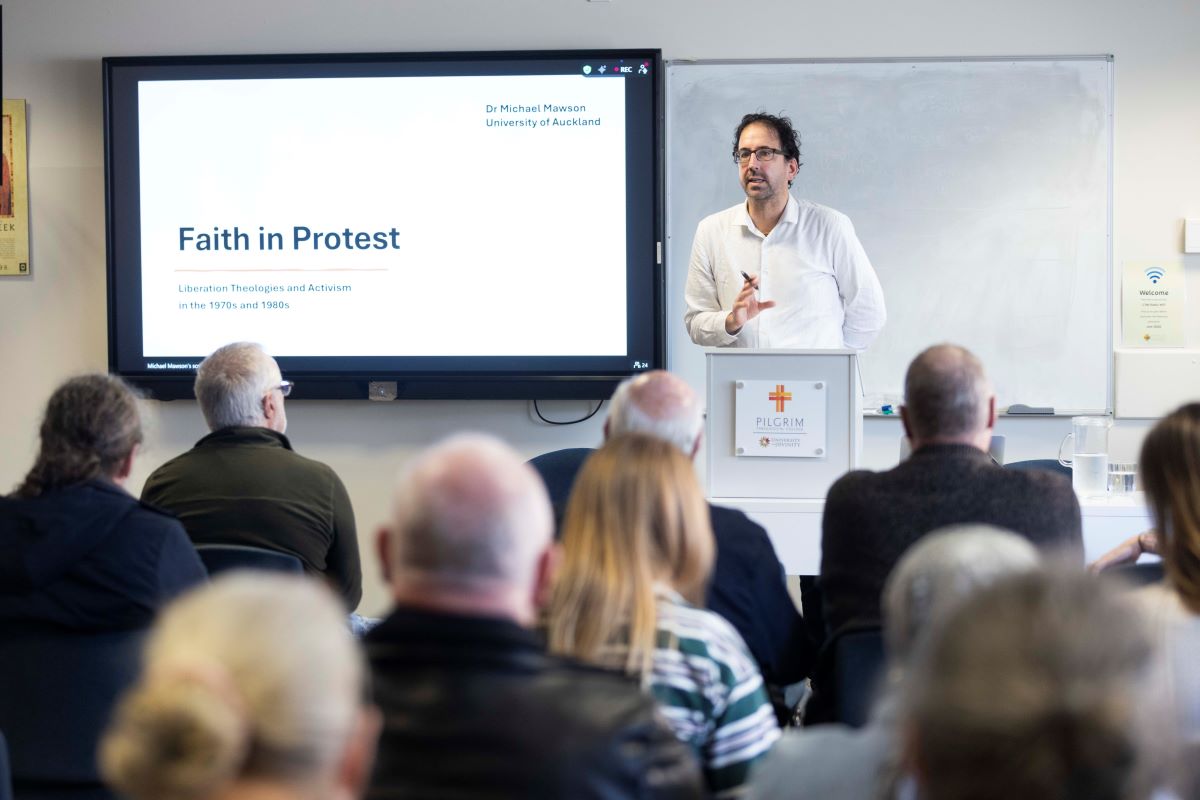
Michael Mawson’s Northey Lecture explored the theological ideas that moved Christians into anti-racist activism. Image: Greg Ford
The program financially supported anti-racism activists, particularly Indigenous groups, and liberation movements. It became best known for anti-apartheid work, but Michael says its influence in Australia and Aotearoa New Zealand is less well understood.
It supported and learned from Māori, Pasifika and Aboriginal activists and helped create networks between campaigners around the world.
The program often worked with the Australian Council of Churches and New Zealand’s National Council of Churches. But its more radical approach also put pressure on those organisations and churches to commit to change.
That approach was controversial. Critics accused the program of fostering violence and supporting terrorism, particularly through its involvement with liberation movements in southern Africa.
The 1983 Waitangi protest illustrates how theological ideas could translate into public action.
The protesters were significantly influenced by liberation theology and the writings of emerging Māori activists and academics. While the protest was small, it generated considerable public debate and, Michael says, helped challenge and shift the views of many Pākehā Christians.
The history also complicates the idea that change happens mainly through dramatic acts of protest.
“Much of the anti-racism work that took place over these decades was slow, unglamorous and close to the ground,” Michael says.
Behind the high-profile protests were smaller workshops, resources and actions that helped prepare people and institutions for change.
Nor was the movement without tensions. Michael says there were disagreements within and between activist groups, and idealism sometimes led to issues being framed in sharp terms that limited the effectiveness of the work.
“It was messy and fraught – nobody had it all figured out.”
He believes messiness is part of the lesson. Churches facing racism and other challenges today can learn from both the achievements and limitations of an earlier generation.
“In our attempts to respond to some of the threats that are facing the world today – racism, the rise of authoritarianism, climate crisis – we don’t need to start from scratch,” Michael says.
“There are examples and work that we can learn from and build upon.”