

By Marina Williams
Across Victoria, the decades-long housing crisis has moved far beyond statistics.
In many towns, the private rental market has deteriorated to the point where families are staying in cars, frontline service workers are unable to secure rentals near their jobs and support agencies are facing confrontational levels of demand.
Federal cost-of-living reporting identifies housing stress as one of the sharpest pressures on households.
In regional communities, rental availability has fallen to historic lows and homelessness services are seeing growing numbers of people who have never previously sought help.
Uniting Housing, the community housing provider of Uniting Vic.Tas, reports vacancy rates in metropolitan and regional centres have fallen to fractions of a per cent.
More than 55,000 households are on the Victorian Housing Register and a further 146,100 low-income households are living in rental stress, in overcrowded conditions or experiencing homelessness.
For many Uniting Church communities, these pressures are visible every week, says Kristie Looney, Executive Director, Housing and Property at Uniting Vic.Tas.
For Kristie, the work she does around housing is personal.
“I was a young teenage mum and raised my son in community housing,” she says.
“Ensuring people have the same opportunity I was given has always driven me.”
Kristie points to ongoing housing issues, such as older residents struggling to maintain large, inefficient homes, people sleeping in cars and frontline workers priced out of living near their jobs.
“The housing crisis is everywhere,” Kristie says.
“(We’re seeing) high cost of living, rising rents and more people accessing services who have never needed support before.”
Demand is also shifting. Workers who previously relied on the private rental market are now among those seeking help. This includes part-time staff, early learning educators, carers and frontline service employees.
“They are priced out completely and there is nothing affordable in the private rental market,” Kristie says.
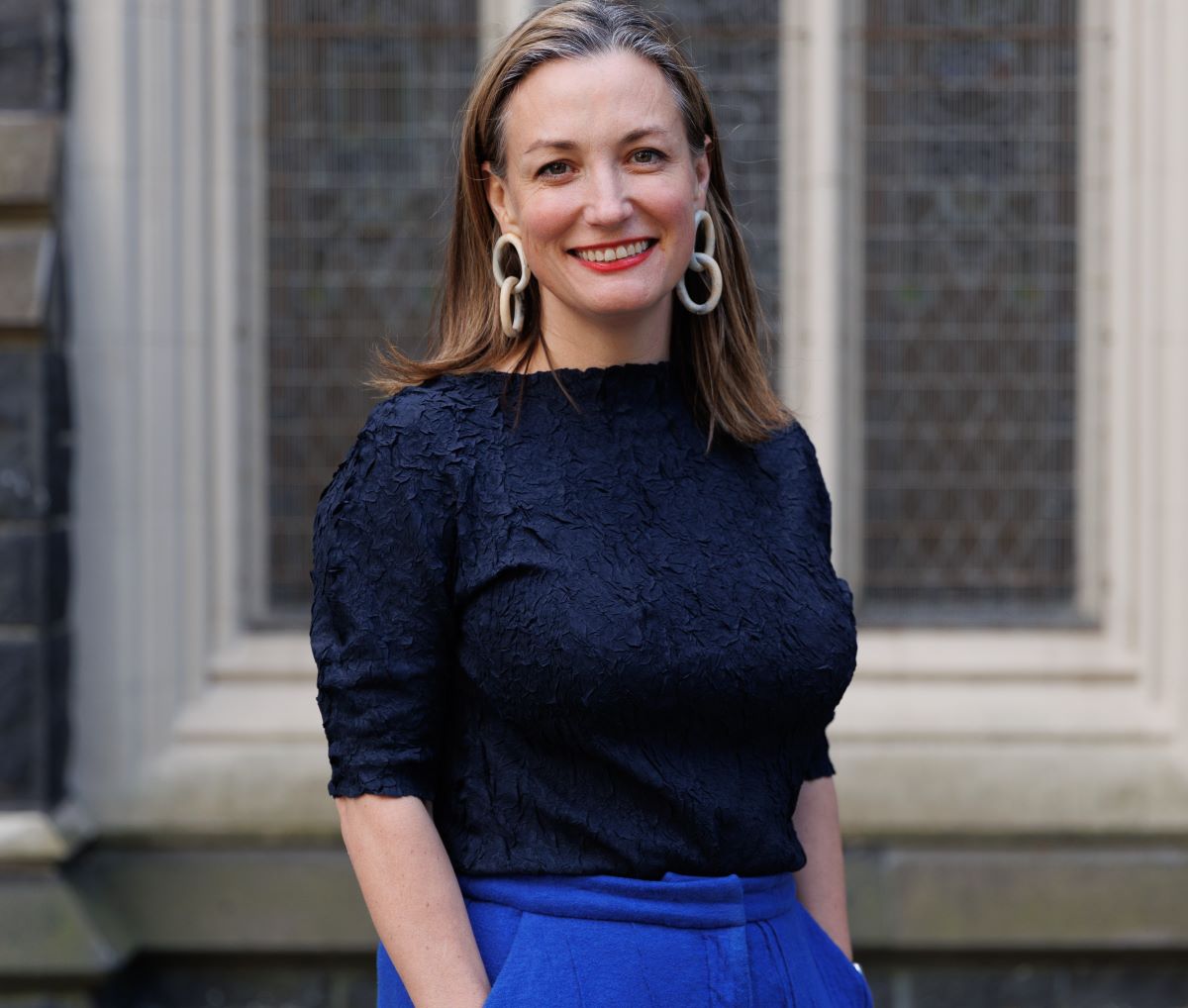
Kristie Looney is passionate about providing affordable housing to people in regional Victoria.
These shifts are prompting some church communities to reconsider how their land is used. Large carparks, underused green space and ageing buildings are raising questions about whether sites could be repurposed for housing.
Kristie says the shift often begins with a simple, local observation that a piece of land is underutilised while community need is rising. That awareness becomes an entry point into the idea of community housing.
“When a congregation starts the conversation, the project has a stronger foundation,” she says.
“They understand the local need and why it matters.”
Turning that intent into long-term housing falls to Uniting Housing. Established in 2020 as a registered community housing provider, it manages almost 900 tenancies across Victoria and Tasmania.
Uniting Housing has three major regional developments progressing or completed. Wangaratta opened early last year, Bendigo is set to open this month and Ballarat is under construction. Each has been delivered through blended funding from government, Uniting Vic.Tas, philanthropy and congregational support.
Bendigo is one of the strongest examples of a partnership in which a congregation-led idea evolved into a major development, Kristie says.
The $44 million project began with a concern raised by the local congregation about women sleeping in cars in the area. A local donor provided an initial $500,000. As the Victorian Government launched the $5.3 billion Big Housing Build, the donor increased their contribution.
“This grew to $4.2 million over five years,” Kristie says.
“As government support came on board and they could see the possibility, each year their contribution increased.”
What started as a modest townhouse proposal grew into three architecturally designed buildings with 73 apartments. St Andrew’s Uniting Church Bendigo and the Axedale congregation made the land available through a 30-year ground lease. Additional funding included $26.3 million from Homes Victoria and $10 million from Uniting Vic.Tas, with operational support through the Housing Australia Future Fund (HAFF).
“The congregation backed it, the council backed it and the community backed it. That collective support made it possible,” Kristie says.
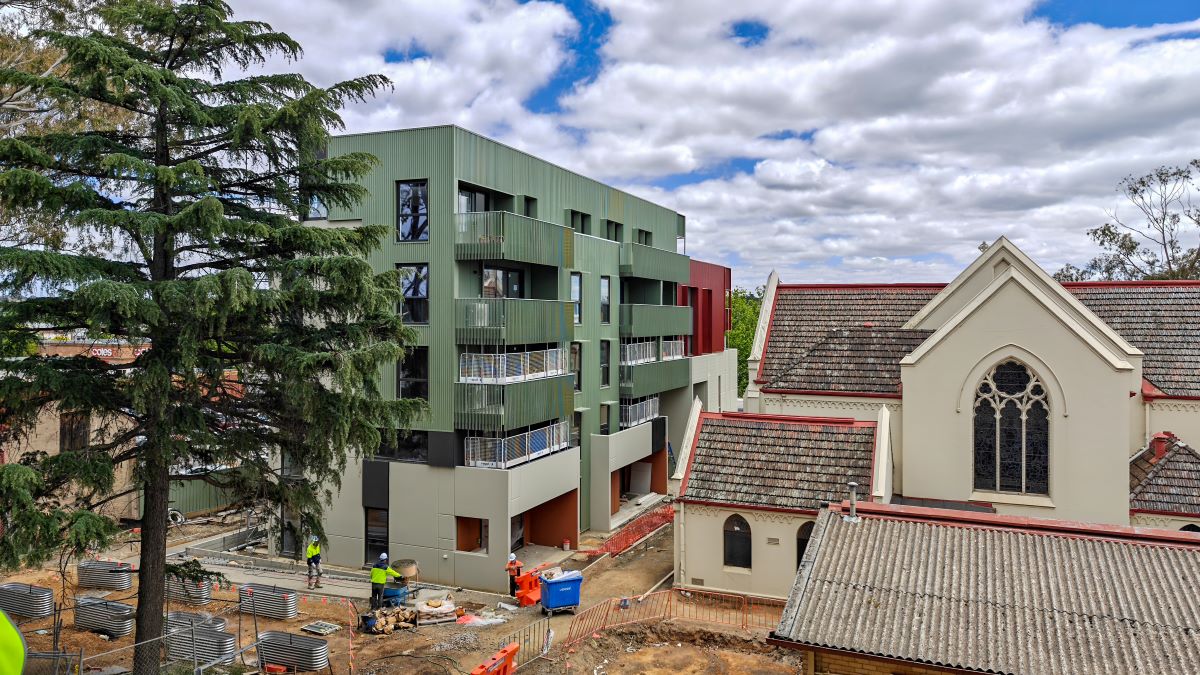
Construction work progresses on the apartment complex next to St Andrew’s Uniting Church in Bendigo, as part of Uniting Housing’s regional building program.
In Wangaratta, where Uniting Housing delivered 44 apartments through Homes Victoria, Uniting Vic.Tas and HAFF operational support, apartment living introduced a new housing type to the regional market. Early concerns about shared living were addressed through collaboration between tenants, neighbours and Uniting staff.
The demand at these sites reflects wider shifts in rental needs, Kristie says. People are leaving unsafe relationships, older women priced out of larger homes are seeking housing they can afford to heat and maintain, and families are looking for smaller, centrally located homes to reduce transport and energy costs.
Across all developments, design standards are intentionally high and the aim is to produce well-built homes that fit convincingly within their neighbourhoods and avoid any design cue that signals disadvantage.
“These are architecturally designed homes,” Kristie says.
“Walking through the Bendigo apartments with the donor was emotional. The tiles, the colour palette, the natural light. It all matters.”
Design quality is accompanied by a stronger focus on renter experience. Uniting Housing has finalised its second 10-year housing strategy and is assessing asset-recycling opportunities, where older, inefficient properties in well-located areas can be redeveloped to deliver a greater number of modern, energy-efficient homes.
Two renters were included on the strategy working group, ensuring lived experience informed decisions about balancing new development with the need to upgrade existing housing. Their participation ensured the needs of current tenants were considered alongside future growth.
“They told us what works and what doesn’t. They reminded us that quality and fairness must apply across the portfolio,” Kristie says.
“We cannot forget the housing we already have in making improvements.”
Stable and affordable housing has measurable effects, she adds.
“People re-enter the workforce, go back to school, reconnect with their kids or simply feel safe for the first time in years,” Kristie says.
“A new home is not the end of the story. It’s the starting point and a critical foundation.”
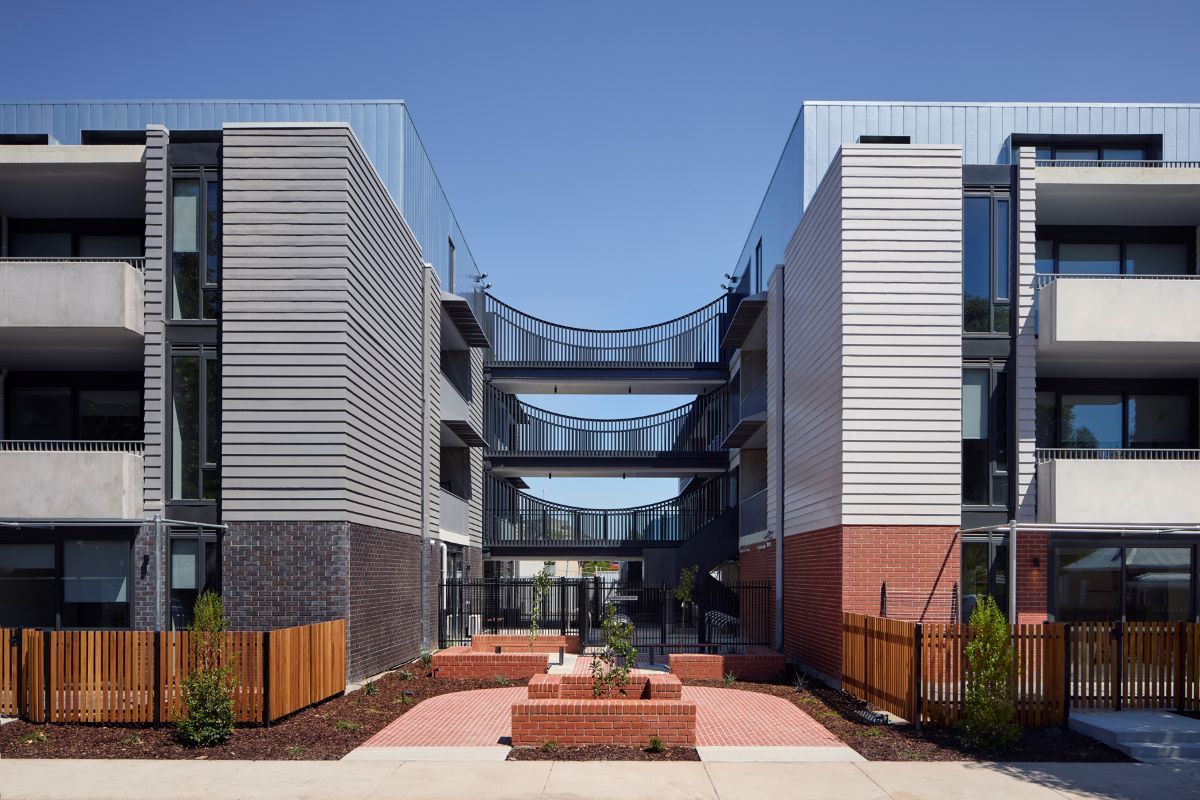
An artist’s impression of the development planned for Ballarat.
Evidence supports this. While Uniting Housing has yet to commission its Social Return on Investment report, a Swinburne University of Technology study estimates each new social home generates more than $4000 each year in avoided health, justice and homelessness costs, as well as nearly $10,000 in savings for tenants through reduced rent and lower energy bills. The Give Me Shelter report finds that every dollar invested in social housing returns $2 in economic and social benefits.
Kristie says these findings align with Uniting Housing’s internal data on improved tenant stability, reductions in crisis service use and better overall wellbeing once secure housing is obtained. Public investment in housing is not a cost, but a catalyst for economic and social progress.
Despite these benefits and progress, Kristie says systemic barriers persist.
“The housing crisis did not happen overnight. It’s the result of decades of under investment, an inefficient tax system and housing being treated as a commodity rather than essential social infrastructure,” she says.
Kristie welcomes recent Victorian Government reforms to accelerate planning approvals and prioritise infill development but says long-term public investment remains critical.
Homelessness services remain under severe strain, she adds, with many providers, including Uniting Vic.Tas, turning away more people than they can assist. Families are often one or two pay cheques from eviction, and some women remain in unsafe relationships because safe housing is unavailable.
Despite the challenges, Uniting Housing continues to expand its development pipeline. Projects are underway or in planning in Ringwood, Coburg, Ivanhoe, South Melbourne, Healesville and Launceston.
Each relies on coordination between congregations, councils, developers, government and philanthropy. Kristie says the partnerships underpinning the Bendigo development show what is possible when local vision is matched with government investment.
“We cannot do this without partnerships. Bendigo shows what is possible when everyone is at the table,” she says.
Uniting Housing welcomes enquiries from any congregation that has underused property or wants to find out more about the process of providing community housing. General email inquiries about housing can be sent to hello@unitingvictas.org.au or to Church Engagement Worker Matt Julius at matt.julius@vt.uniting.org