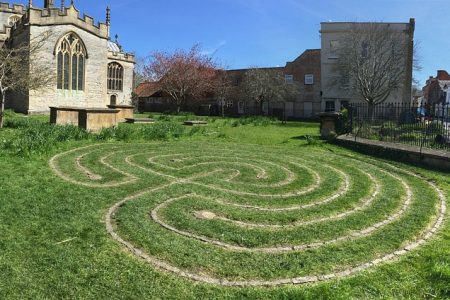

Journeying and discerning with labyrinths
Like any prayer practice, it can take time to become acquainted with how you might engage with labyrinths for discernment. Be gentle with yourself as you explore this practice. If there is part of you that is curious and excited to explore, allow time for adjustment and growth.
There can be something of the ‘wilderness or desert experience’ about engaging with labyrinths – on the way in, we are invited to shed that which is weighing us down and holding us back from deciding, discerning, or listening. What is God saying to us in the silence of our hearts in the centre of the labyrinth? Having received, the return journey is a time of consolidation and integration, picking up life again in a new way.
For those who are new to labyrinths, check out the following information:
- “Walking the Labyrinth: A Practical Guide” – a brief, but useful guide.
- Veriditas, a global community promoting the use of labyrinths, has written information about labyrinths and a short video.
Journeying a physical labyrinth:
Labyrinths can be found in Victoria and Tasmania through the following websites, which also give information about location (privately owned or public space) and access:
- Australian Labyrinth Network – for those who like a visual map
- Labyrinth locator
- Melbourne Playgrounds – Labyrinths
Hand-held/finger labyrinths (where your fingers do the travelling) can be accessed by:
- downloading and printing a labyrinth. You can find a couple from The Labyrinth Society. If you are looking for something a little different, you can find some from the World Labyrinth Day site.
- using an app on your device
- purchasing or making a physical hand-held/finger labyrinth (wood, cloth, metal, clay, sand, paper, string, etc)
- For those who would like to create their own labyrinth from scratch, Lars Howlett (labyrinth designer and builder) has videos and templates on how to draw labyrinths.
For some information and guidance on using a hand-held/finger labyrinth see:
- Finger labyrinths – Jill Geoffrion
- Praying with a finger labyrinth – The Upper Room
- Tips for using finger labyrinths – Lars Howlett
Writing a labyrinth:
The process of ‘writing a labyrinth’ involves 2 printed copies of the same labyrinth – one for the way in, and one for the way out. The Chartres or Cretan/Classical labyrinth shapes can be used. Writing implements are also needed.
Download a simpler version of the Chartres labyrinth.
Download a Classical labyrinth.
There is no right or wrong way of ‘writing a labyrinth’, just as there is no right or wrong way of walking or travelling a labyrinth. What is offered below is a starting point that may be helpful if you have not engaged in this practice before. It is loosely based on Lauren Artress’ 4R’s or “Four Fold Path” for meditative walking a labyrinth. You can find more about this in her book The Sacred Path Companion: A Guide to Walking the Labyrinth to Heal and Transform, New York: Riverhead Books, 2006. For those new to labyrinths, please also note that blessing, releasing, receiving, and resolution, discussed below, are not states that are fixed to any part of the labyrinth. They can occur at any time in the labyrinth. It is ultimately about flow.
Stage 1 – Remember
Pause before ‘entering’ the labyrinth and beginning to write. Take some time to remember you are blessed.
Stage 2 – Releasing
This stage begins at the beginning of the entrance to the labyrinth and ends in the centre. When writing a labyrinth, this stage will take up a whole labyrinth. What are you shedding, letting go, trying to quieten, or open up? Write along the path of the labyrinth until you have emptied all you have to say. Using your writing implement, mark the rest of the path (eg. line, dots, images) until you reach the centre of the labyrinth.
Stage 3 – Receiving
Having been through a process of emptying and release, what are you now open to receive? Are there any insights, creative possibilities, or guidance received? Stay in the centre for as long as you need.
Stage 4 – Resolving
This is the journey from the centre back out of the labyrinth. When journeying in a physical labyrinth, we use the same path in and out. When you are writing a labyrinth, you use the second labyrinth to write in as you move out of the centre. What sense of rebirth or rejuvenation is occurring as you move out of the labyrinth? Have you come to some resolution about a question or decision you have been pondering? Is there a feeling of strengthening or integration?
Before you exit the labyrinth, you may wish to express your thanks and gratitude for the journey.