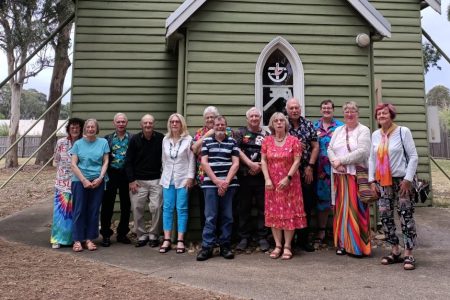

Croydon Uniting Church
Funding from the Synod Emissions Reduction Fund was critical in enabling the congregation to install solar panels sooner than anticipated.
While we had long held a desire for such a project, this funding helped accelerate it.
We worked with Senior Social Justice Advocate Mark Zirnsak to choose an ethically produced system, manufactured without slave or forced labour.
We chose a 17kW system that meets our church’s current needs and was below $20,000.
Our project necessitated regular discussions with the Church Council, and we thank them for their patience as the project goalposts frequently shifted.
Late in the process, we discovered that Synod Property Services required an engineering roof inspection. This was fast-tracked and completed on Boxing Day, permitting a February installation.
The whole process took six months of planning and negotiations with suppliers, Church Council, and Synod to reach installation day, but was well worth it.
Our panels have been active for three months and have saved 2500kg in CO2 emissions in that time, according to our monitoring app.
Financial modelling from our supplier predicts that the cost of our system will be paid off in 5.4 years.
We are pleased to be making a tangible contribution to the Synod’s zero emissions goal, and are also deeply grateful to Mark Zirnsak for his guidance and for access to Synod SERF funding.
Peter Smerdon
Brunswick Uniting Church
The congregation has been tracking the emissions of appliances in the various church buildings for a number of years using their utility bills.
The SERF initiative allowed us to think about replacing the next biggest emitters on the appliance list: two very hard-working hot water heaters.
Putting together the SERF application was reasonably straightforward, with just a bit of work with vendors to ensure that quotes for the new heat pumps included supply, installation and a claim for the government rebates.
Brunswick Uniting received $6444 from the SERF, allowing the purchase of two heat-pump hot water systems that are more reliable, cheaper to run, and have a far smaller carbon footprint than the units they replaced.
When Brunswick comes to study the church’s latest utility bills later this year, overall emissions should be lower still and close to half of what they were in 2014 when this decarbonisation journey began.
The congregation benefits from better stewardship of the church’s financial resources, carbon footprint and ultimately care of the environment and planet.
James Clough

Student Matilda with a heat-pump hot water system installed at Brunswick Uniting Church’s Student House.
The Village Church Mount Eliza
The congregation formed a Toward Zero Committee in May 2021 to respond to the Assembly’s call to reduce our emissions.
The church had substantial building maintenance issues to deal with but managed to abolish gas at the manse and install 10kW of solar panels at the church-community centre in 2022-23.
The application process for a SERF grant for a quality heat pump hot water service in October 2024 was very straightforward and approved quickly.
The grant, the tendering process and installation all were completed by April this year.
This assisted the Village Church to move one step closer to fully abolish gas and achieve a sustainable electric future.
The timely support from the Synod was much appreciated.
Cam Opie and David Arnott
Warragul Uniting Church
The congregation was successful in getting a 2024 SERF grant for $10,000 to replace outdated ducted natural gas heating and evaporative cooling with split system air-conditioning.
Seven, eight and 9.5Kw air-conditioning units were installed in March and the natural gas supply was disconnected soon after.
Together with solar, LED lighting, heat pump hot water and electric appliance projects already completed, the church and kindergarten are saving about $15,000 per year in energy costs, and CO2 emissions are reduced by an estimated 13.5 tonnes per year.
The grant enabled the church to proceed with the final project, without further depleting its reserves.
The SERF application process, although requiring considerable detail, was easy to manage.
The benefits of the project to our church are significant and importantly, our future sustainability has been greatly enhanced.
David Morison
Highfield Road Uniting Church
In 2024 the Highfield Road Uniting Church, Canterbury changed its four old-style gas heaters, located in the hall, to two electric split-system airconditioning units.
This was made possible with the assistance of the Synod Emissions Reduction Fund, which contributed about 50 per cent of the cost.
Here at Highfield Road we are now looking to install solar panels to further us on this path of emissions reduction.
The obvious advantage with the change from gas to an electric split system is the reduction in gas usage and thus the saving of money, better control of temperature and the ability to cool the air on hot days.
This was not previously available to us.
Richard Nixon

Solar panels are installed at Croydon Uniting Church.
Fund drives zero emissions goal
The recent Synod 2025 meeting committed to continue funding for SERF, recognising the important role the fund is playing in the goal of reducing greenhouse gas emissions.
At the August-September meeting, Synod members resolved “that the Synod provide up to $100,000 to the Synod Emission Reduction Fund that would match, dollar-for-dollar, contributions from presbyteries, congregations, faith communities and individuals up until the next ordinary meeting of Synod”.
The resolution means that there is potentially $200,000 available for congregations wanting to access the fund.
The Port Phillip West Presbytery has already pledged $30,000, meaning $60,000 has already been raised for the fund.
The most recent SERF resolution once again aligns with the Synod’s aim to reach zero greenhouse gas emissions by 2040 at the latest.
The SERF was introduced at the November 2023 Synod meeting and provided $100,000 as the initial amount for the fund.